自主軟件 (Software as Self-Determination)
Interactive exhibition on Chinese technological sovereignty, developed entirely with Chinese software.
Yale-NUS College2022
Project Name
Project Date
Affiliation
Team
Joshua's Contribution
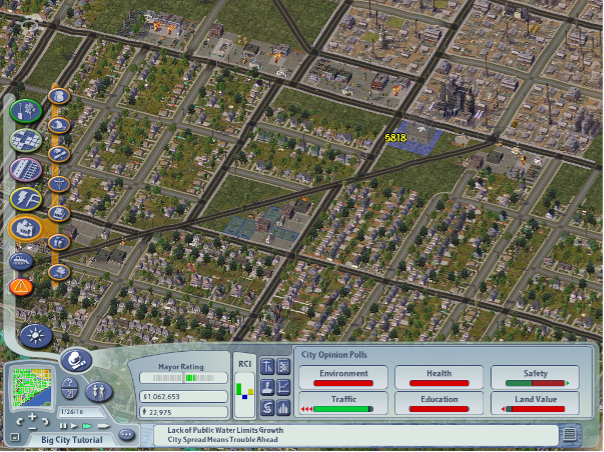
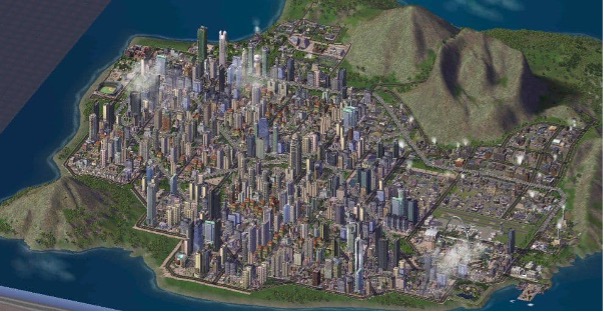
Many young aspiring urban planners come to know of the profession through their exposure to the popular video game franchise SimCity, which presents players with a mechanistic model of urban growth and development. Aware of the game’s ability to interest children in urban development, the One Laptop Per Child (OLPC) project worked with SimCity publisher Electronic Arts to ‘donate’ SimCity, bundling the game with OLPC laptops distributed to children in Global South countries worldwide. What does it mean for a piece of software – e.g. a video game – to attempt to model a process as complex as urbanisation? How does that affect people’s understanding of such complex social processes? And what does it mean for SimCity – a video game rooted in a specific American context – to be the foundation of urban imaginaries for children not just in the United States, but around the world? I explore these questions in this paper. Through archival research, I trace SimCity’s roots to a 20th century movement to model complex socio-economic systems using mathematical models. I use SimCity as a reference point to introduce the reader to critical scholarship questioning the ability of such computational models to represent urbanisation. I then look at how SimCity often portrays itself as ‘realistic,’ defined as being accurate and/or value-neutral, and make the case for why SimCity is neither accurate nor value-neutral, arguing that SimCity manipulates how players understand urbanisation in ways that can privilege certain ideological tendencies. Finally, I show the importance of this conclusion by returning to the OLPC donation. Drawing connections between Global South urban theory, OLPC’s pedagogical ideology, and psychological studies showing how SimCity impacts global south children’s attitudes towards urbanisation, I ultimately argue that SimCity could be considered a form of electronic colonialism and ask readers to reflect on how software can shape reality.
This paper was originally produced for the YSS3222 Urban Theory course at Yale-NUS College, Singapore, taught in AY2021/22 Semester 1 by Ricardo Cardoso. The course covered key thinkers in urban theory. Assessments comprised two essays (~2000 words), and classes were in small-group seminar format. Part I of the course covered “foundational motifs” in urban theory, including works from Wirth, Burgess, Marx, Engels, Lefebvre, Harvey, Glaeser, Sassen, and others. Part II covered contemporary urban theory, including works from Schmid/Brenner, Roy, Marvin/Graham, Jacobs, Simone, Robinson, Crawford, Batty, Mattern.
This paper was my attempt to synthesize a number of threads, including early theory around cybernetics and the city, the applicability of system dynamics (Forrester), and critical smart cities studies (Mattern), and extends these through analysing their implications in the context of a video game (SimCity) receiving new audiences in the Global South. This paper was of course influenced by my own childhood in the Philippines learning gameplay mechanics inspired by American planning and real estate mechanisms while growing up in cities that had a very different political economy.
The paper received a Global Undergraduate Awards 2023 Regional Award in Social Studies (Culture and Anthropology).
Essay on GUA LibraryThis acknowledgements section is reproduced from my 2021 original student submission.
While much of this essay is a critique of SimCity’s design, impact, and essential ideas, I owe a lot of my academic interests, career trajectory, and life (frankly speaking) to the game that defined my childhood and inspired me to take up Urban Studies. The many cities I created as a kid taught me that vision can make a better world. The contradictions between the game and my lived experience taught me that no one vision can represent the needs, dreams and aspirations of a population.
I have always wanted to write an academic paper on SimCity, but wasn’t sure if I would be able to make something intellectually satisfying. I want to first thank prof Cardoso for encouraging me to focus on this part of my original essay proposal, which used SimCity only as a smaller example in a larger narrative about technological imperialism. I realised that poking deeper at my personal interests allows me to carry over that enthusiasm to my writing, and there was barely enough space for this ‘focused’ section of the topic anyway.
I was inspired to question the ideologies underpinning SimCity by socialist critiques of the game. In particular, I think Paolo Pedercini’s presentation at the 2017 Rotterdam International City Gaming Conference brilliantly analyses SimCity’s inclination to capitalist growth. His and other socialist critiques ultimately did not form the basis of my methodological approach, but nevertheless I want to credit them for inspiring me to investigate this topic.
I am also very thankful to NUS Libraries for having an excellent collection on this topic. I was scared that it would be harder to access the necessary literature than if I limited myself to the texts in the course, but some groundbreaking texts in computational urbanism – including Forrester’s 1969 Urban Dynamics all the way to Mattern’s critique of the field in 2021 – were available at both the Yale-NUS Library and the NUS Central Library. Reading Forrester’s book firsthand, the book that inspired SimCity’s creators, was eye-opening. While prof Cardoso told me that I did not need to read this original book to make my argument, I am glad I did – even though it took up time – because I felt I understood the project of urban dynamics more clearly. While I still am critical and skeptical of computational urbanism, at the same time I disagree with some aspects of its interpretation by socialist critics and wanted to more fairly portray Forrester’s work while still examining it through the lens of critical literature.
Lastly, my experience working part-time at the Future Cities Laboratory Global, which has its own smart city software project (ur-scape), helped me see from the perspective of smart city software designers.
Click on an image to expand it.
Tap on a photo to expand it.
code + design + sound © 2026 joshua vargas